You've pre-ordered your new iPhone 12 or iPhone 12 Pro and now all you can do is wait until next week for it to arrive. Well, almost all you can do. Despite the fact that the iPhone 12 sports some of the most durable glass ever used in an iPhone display, the fact remains that the back of the iPhone 12 Pro is still normal iPhone glass, and the stainless steel that adorns the sides is just begging to get scratched or dented. (Fun fact, the iPhone 4, from which the iPhone 12 borrows its design cues, was the first iPhone I ever shattered — twice.)
Suffice to say, you're going to want to protect your new phone. The good news is that there are already tons of awesome iPhone 12 Pro cases that are either available for pre-order or are shipping soon. Oh, and if you happen to be getting an iPhone 12, these cases will work for the non-Pro model as well. From the new magnetic MagSafe iphone cases to clear cases that will show off your iPhone 12 Pro’s colors, these are some of the best iPhone 12 cases you can buy right now.
1-Let's go with the first one, it's came with a camera protection and four colors Black, Purple, Green and Blue
the price is Cheap and good for me 9.14$ and 1.99$ for shipping cost via USPS.
You can read more details about this case on eBay.
2- Especially if you've picked up one of the new colors, you might be hesitant to cover up your new iPhone 12 Pro. That's why these clear cases are perfect for adding drop protection (and maybe a bit more), while keeping your new device safe.
the price is very Cheap for this case too and good. just 9.95$ + 2.15$ for shipping cost via USPS.
You can read more details about this case on eBay.
Apple's official clear case is a bit blingier than expected, with the MagSafe magnet that makes popping the case on and off prominently on display. Of course, clear magnets aren't a thing, so that's to be expected. But it makes for a bit of visual pop in what's usually one of the more staid case choices.
3-For this one, it's my favorite case, I bought it for my iPhone and it's relly very amazing guys, this is the right chose for your iPhone, And I encourage you to buy it too. 100% high quality, I got it in just 4 days. It really has an attractive view. It gives your iPhone the prestige of Thomas Shelby. This easy to install one-piece case from Otterbox is completely clear, so your color of choice can shine through! While it doesn't have the antimicrobial protection of the Series+ cases, it still has the three-times military drop protection and is compatible with their full line of Alpha and Amplify glass protectors. It also comes in glittery and more opaque varieties if you want "clear, but with some style"
the price is very Cheap for this case too . just 16.14$ with a free fast shipping via USPS.
You can read more details about this case on eBay.
If you're looking for a clear case made from a truly unique material, then you'll want to check out these crystal-clear cases from Nimble. Nimble cases are made from post-consumer compact discs (which are mostly made out of polycarbonate). The plastic is treated so that it resist scratches and yellowing, making sure it looks just as clear in a year as it does when you pop it out of the (plastic free) packaging.
It also has a permanent antimicrobial treatment so that your iPhone stays germ-free. Nimble has done edge-test drops of up to 6-feet, so you can feel confident that your iPhone 12 is protected from drops. I especially like that in every package there's an e-waste recycling bag so that you can properly dispose of your old case (or earbuds or batteries). Doing so will get you 15% off your next Nimble purchase.
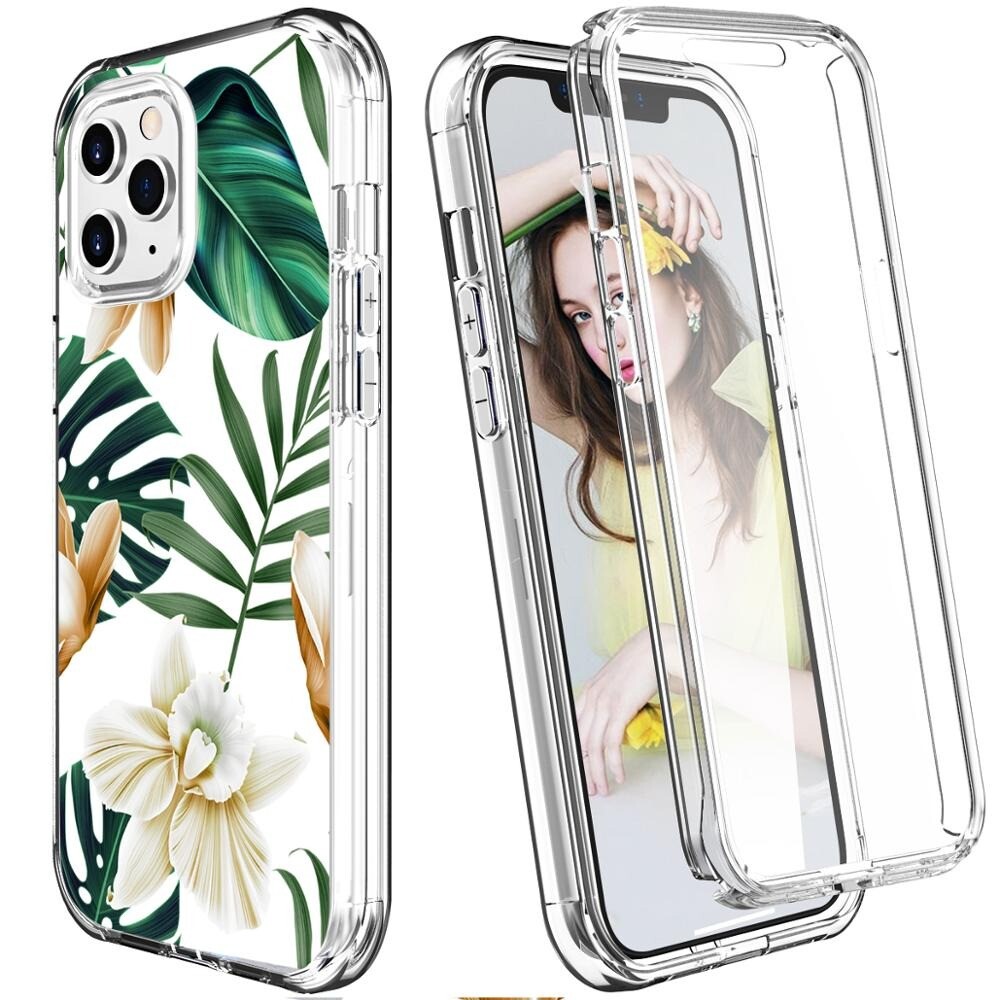
4- the last one, this case have Dual Layer + Screen Protector, it's relly very amazing guys, it's really really amazing because the awesome colors, it's especially for the girls, boys you can buy it too of course if you like it. 100% high quality. It really has an attractive view.
the price is very Cheap for this case too. just 15.49$ + 2.19$ for shipping cost via USPS.
You can read more details about this case on eBay.
Made from 50% recycled materials, the Casetify Ultra Impact cases also have an antimicrobial coating to keep your iPhone 12 Pro germ free. The bigger bumpers on the Impact case will protect against drops of up to 9.8 feet. And like all of Casetify's products, it's fully customizable. If clear isn't your thing, There are hundreds of designs and customization options on the Casetify site.
You bought your phone for $699 or more so you should buy him a case to protect him from scratches. Imagine with me that your phone got scratches. Imagine what it looks like then, you'll regret not buying a case then, I'm talking through my personal experience, and you can only buy it for $10 now.
thank you guys for your time, don't forget to support me with share this post with your friends.
Production was disrupted, reducing supply; many retail stores were closed in early March, leading to fewer purchase opportunities; and lost income during lockdowns would have reduced demand for expensive consumer electronics purchases …
Mobile phone shipments in China in March totalled 21 million units, according to data from the China Academy of Information and Communications Technology (CAICT), a government think tank.
That was a more than three-fold increase from February, yet still down roughly 20% compared with March 2019.
Apple shipped roughly 2.5 million iPhones in China in March, a slight rebound after one of its worst months in the country ever, according to government data published on Friday.
The Cupertino company doesn’t reveal unit sales, but the Chinese government publishes data on total smartphone sales and on Android sales, with iPhone sales making up the difference between the two.
While China was hit first, tough lockdown measures have created hope that the country will also be the first to recover, meaning that tech firms will be looking to the region for some relief in the face of a global recession.
Chinese retailers largely resumed operations by early March, with brick-and-mortar outlets re-opening and e-commerce logistics getting back in gear after the virus and tough containment measures brought much of the economy to a standstill in the first two months […]
Many smartphone makers are now hoping that sales in China can cushion declines in overseas markets in coming months.
Read Also: Samsung Galaxy Chromebook review
Local brand Xiaomi recently revealed its own earnings report, in which the company’s CFO said that Chinese smartphone sales were now back up to 80% of normal levels.
There do remain some doubts, however, as to the accuracy of the health data published by the Chinese government, which is extremely keen to see the country return to full production as quickly as possible.
If you haven’t noticed, there’s a new first-person shooter taking the internet by storm. And no, I don’t mean Call of Duty: Warzone, although that’s also blown up in recent weeks. Instead, I’m talking about Valorant, the first title by Riot Games that isn’t set in the League of Legends universe. Riot’s new video game, Valorant, is both a breath of fresh air and completely unoriginal at the same time. The first-person shooter opened its closed beta on Tuesday to gargantuan Twitch viewership, thanks in part to Riot’s deal with the platform that let popular streamers gift access keys to its beta while they played the game live. After watching many hours of the game and playing quite a few myself, it’s clear that Valorant is a hyper-competitive game catering to perhaps a small slice of the overall gaming community. (Right now, it’s only on PC, with no plans for a console release.) But that doesn’t matter, because it already seems quite likely to be the next big esports sensation, despite its hardcore nature and the fact that it borrows almost every single component of its design from previous competitive titles. The closest parallel is Counter-Strike: Global Offensive. Almost everyone who has played the game says the movement and twitch-based shooting feels similar to Valve’s long-running franchise. The colourful art style and character abilities, which include ice walls, poisonous gas and trip mines, have also drawn comparisons with Blizzard’s Overwatch. Most of the powers revolve around visibility, though, and limiting your opponent’s sight lines. So while it may look like Overwatch, you shouldn’t expect too many over-the-top weapons and finishers.
That’s partly because Valorant, even in its beta form, is arriving at a crucial moment for the competitive gaming scene. Much of the esports world revolves around multiplayer online battle arenas, or MOBAs, like Valve’s Dota 2 and Riot’s own megahit League of Legends. There are peripheral esports communities, like the fighting game community and those that surround individual games like Psyonix’s Rocket League, that exist as niche subcultures within the broader esports field, but MOBAs reign supreme.
Image: Riot Games
The response from early testers has been overwhelmingly positive. And some professional gamers, including Harrison “Psalm” Chang — the runner-up at the Fortnite World Cup last year — have already said they’ll be switching to the game full time. This week, Riot launched a closed beta program with various streamers, influencers and esports teams. But here’s the kinda genius part: some Twitch streamers have a special "Drops Enabled" tag that means random viewers will be given beta keys. That’s kept the viewership and general interest around the game unusually high. Only games made by companies with immense resources like Activision Blizzard with the Call of Duty League and Overwatch League and Epic Games with Fortnite have dared to try to buy a seat at the table through unique league structures, high-production values, and massive prize pools. That’s precisely why Valorant seems primed for success. Simply put, the game combines character-specific superpowers heavily influenced by Overwatch with a tense, high-intensity tactical shooter model more or less carbon-copied from Counter-Strike: Global Offensive. Riot is attempting to build a modern Counter-Strike, one that appeals to a generation of MOBA fans that grew up on the idea of honing your skill as a specific hero with unique powers and an ultimate ability to use in crucial, match-defining moments.
Going from the early reception on Twitch, Valorant is getting that recipe right in a way that might pull big streamers and pro players away from other games. The game broke Twitch’s record for most-watched ga We don’t know if Valorant will be a hit when it actually launches. But the early signs are positive, and with Riot's stewardship there's a good chance it could turn into a heavyweight esport just like Counter-Strike: Global Offensive, Call of Duty and Tom Clancy’s Rainbow Six Siege. There’s another factor that could contribute to the game’s success: Valorant is not a battle royale game. Riot is bucking the trend that’s taken the gaming industry by storm for the last three years or so by releasing a tactical shooter. Since the release of PlayerUnknown’s Battlegrounds in early 2017, BR games have consumed the shooter market. Fortnite is one of the most dominant games on the planet across all platforms, while a number of competitors have popped up to try to capitalize on Epic’s moneymaking potential, like Respawn’s Apex Legends and Activision’s Call of Duty: Warzone. But we’re also experiencing a bit of BR fatigue, as the initial excitement of the genre fades and its esports potential has proved hit-or-miss.
Image: Riot Games
Valorant is just the tip of what Riot Games has planned for 2020, however.
Take Legends of Runeterra. The digital card game was announced last year and released in open beta a few months back. For now, it's a PC exclusive, though the final version -- scheduled to launch on April 30th -- will also be available on Android and iOS devices.
There are already tons of digital card games to choose from, including Hearthstone, Gwent, Magic: The Gathering Arena, The Elder Scrolls: Legends, Artifact, and even an online version of the Pokemon Trading Card Game. So why care about Legends of Runeterra? For one, it's packed with cards and general references to the League of Legends universe. So if you play Riot’s MOBA religiously, or have any interest in the game's champions and lore, it might pique your interest.
For another, it has an arguably fairer economy. Legends of Runeterra doesn’t rely on digital booster packs filled with random cards, for instance. Instead, it has something called Wildcards, which can be earned for free or bought with a premium currency. It’s then possible to trade these special cards for something specific of the same rarity. That means you don't have to rely on pure luck to obtain a critical card for your next deck.
If cards aren't your jam, there's also Teamfight Tactics. The strategic battler, inspired by Dota 2's popular auto chess mod, launched on PC and Mac through the League of Legends client last year. It was a huge success, and last month Riot released it as a standalone game for iOS and Android. If you prefer the classic MOBA, though, good news: a special version called Wild Rift is coming to consoles and touchscreen devices later this year. The port could have its own thriving playerbase, of course, like Arena of Valor and other touch-friendly MOBAs. But it could also encourage newcomers to try the original desktop version, strengthening the decade-old community and Riot's main source of revenue.
The League of Legends developer is also prepared to work with external partners. It's already commissioned Arcane, an animated TV series set in the League of Legends universe. We don’t have an exact release date, but an early trailer suggested it would be out this year. There’s also Riot Forge, a publishing initiative that allows third-party developers to make games with the League of Legends license. Two titles have been announced so far, called Convergence and Ruined King. Neither has a release date, but it's possible at least one of them will come out this year, further expanding the brand's exposure.
And let's not forget about professional League of Legends. Esports are in the spotlight right now. While every traditional sport is shut down and bleeding money, professional League is somehow putting on games every week, pulling in viewers and delivering on its advertising and sponsorship agreements.
So long, DualShock. Sony has taken the wraps off its PlayStation 5 controller and it won’t be clinging onto the branding that has adorned controllers through the last several consoles. Instead, the latest peripheral is called the DualSense, and Sony has at last revealed what it actually looks like beyond patent applications.
The new controller has some big changes on the inside, too: the previously announced haptic feedback (replacing the old rumble technology in previous controllers) and the new “adaptive triggers” that can adjust the resistance of the triggers for different gameplay effects. There’s also an integrated microphone, a first for Sony’s controllers, along with a (long-overdue) USB-C port. And of course, there’s the new two-tone color scheme (similar in style to the PSVR) and an overhauled design that gives a more rounded shape to the grips and face buttons.
The DualSense has a built-in microphone array, so you can chat with your friends without needing a headset. The DualShock share button is no more, with a Create button taking its place. Sony will spell out exactly what you’ll be able to do with that in the coming months. A closer look at the rear, meanwhile, suggests that the DualSense has a USB-C charging port.
Some of the buttons on the DualSense are also getting some light tweaks compared to the old DualShock 4 — the PlayStation button, for example, is now cut out in the actual shape of the PS logo, while the triggers have received a more angled design than past Sony controllers.
Other features from the DualShock 4 will still remain on the DualSense, like the center-mounted touchpad and the light bar (although the bar has been moved from the top / back of the controller to the left and right sides of the touchpad). Sony is also sticking with its symmetrical controller layout, with the D-pad and face buttons on the top half of the controller and the matching analog sticks on the bottom.
Further details about the DualSense — like how much additional controllers will cost, or if Sony will be offering more color options — will presumably be announced close to the PlayStation 5’s fall launch. For reference, the DualShock 4 cost $59.99 when it was first released.
The PS5 is still on track for a holiday 2020 release date, so it’ll only be six months or so before we find out how true that statement is, as well as whether the DualSense is as comfy as it appears. However, we’ve still no idea what the console itself looks like. Fingers crossed there’ll be more details on that front soon.
Who is buying a $1,000 Chromebook? That’s the question people debated across the internet when Google unveiled the Pixelbook in 2017, and it’s a debate that will continue as the 2-in-1 Samsung Galaxy Chromebook makes its way onto shelves.
In a market packed with laptops that are getting thinner and faster each year, a Chromebook’s comparative advantage is usually in battery life and price. Sure, a number of companies make Chromebooks that are meant to compete with Windows machines on specs and performance, but those “premium” Chromebooks (aside from the 2017 Pixelbook) don’t carry starting prices above $650, and many (such as the Asus Chromebook Flip C434) are under $500.
google has been selling expensive, high-end Chromebooks for years now. But last year, the company changed tactics. The Pixelbook Go was “only” $650, a far cry from the $1,000-plus price Google asked for its previous Chromebooks. Google cut a few corners to hit that price point, but the Pixelbook Go was easy to recommend as a Chromebook that almost anyone could use as a full-time computer. But if you were one of the few out there who has been clamoring for a follow-up to 2017’s Pixelbook, the Go didn’t quite meet the mark.
Enter Samsung. At CES earlier this year, the company showed off the stunning Galaxy Chromebook, a computer that really does feel like a successor to the original Pixelbook. Amenities include a gorgeous 4K touchscreen, a stowable pen, lots of storage and processing power, and an sleek, all-metal enclosure. And you can’t miss it in that bold red color. On paper, it’s a capable and well-designed computer, easily one of the best Chromebooks on the market. But at $999, we’re asking a familiar question: should anyone spend that much money on a Chromebook?
Pros and cons of Samsung Galaxy Chromebook
Excellent keyboard
Fast performance
The Chrome OS platform is solid and stable
Beautiful and pixel-dense display
Thin and light design with strong build quality
Battery life is poor
Screen ratio makes things feel cramped
Expensive
Summary: Samsung’s latest Chromebook does a lot of things right. The keyboard and screen are standouts, and it’s a very well-designed laptop. But for $999, its poor battery life is almost impossible to forgive.
Hardware:
Nathan Ingraham / Engadget
There are no two ways around it: The Galaxy Chromebook is a head-turner. The metallic red pops like few other laptop colors I’ve seen over the years. (You can also get the laptop in a more pedestrian gray, if that’s your jam.) It’s not just the color, though: The Galaxy Chromebook’s silver metal edge is squared off, not contoured like most laptops. It’s near-identical to the design of the original Pixelbook, and it helps the computer stand out when it’s closed.
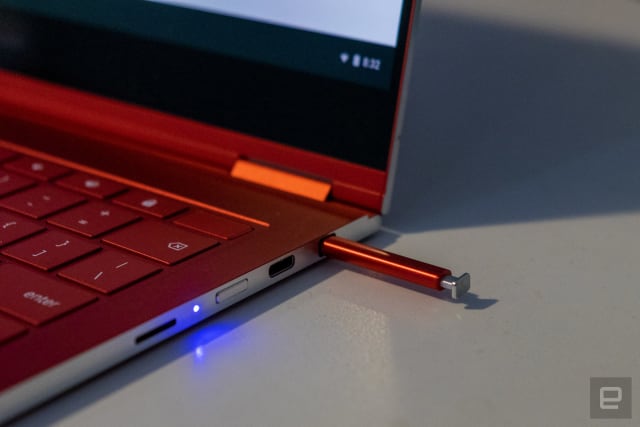
The Galaxy Chromebook has an intriguing set of ports and features. For starters you’ll notice two USB-C connections, one on each side. Samsung also included a microSD card slot -- I would have preferred a standard SD slot, but it’s better than nothing. Since the Galaxy Chromebook has a 360-degree hinge, there are two small speakers on the side for when you have the laptop flipped into tablet mode. The power button is also on the side along with a volume rocker. Finally, there’s a slot for the included stylus, which feels quite similar to those included with Samsung’s Chromebook Plus and Chromebook Pro from 2017.
The Galaxy Chromebook’s tiny side speakers had me a bit worried about audio quality, but I came away pleasantly surprised. There’s a third larger speaker underneath the laptop that fires into your lap or a desk, and the combination of that and the smaller speakers do a good job for music playback and YouTube videos. They’re not as good as the excellent speakers on the MacBook Pro I use every day, with a bit less overall volume and bass response. They’re also a little bit tinny, as many laptop speakers are, but they’re definitely better than I expected.
The Galaxy Chromebook’s 360-degree hinge lets you flip it around and use it as a tablet in a pinch, or prop it up for watching videos. I’ve never found 360-degree modes very useful. Even though this computer is only 9.9mm thin and weighs about 2.3 pounds, that’s still a lot bigger and heavier than my iPad. But, it makes for one very compact laptop. It’s ever-so-slightly slimmer than the original Pixelbook, and much thinner than the Pixelbook Go.
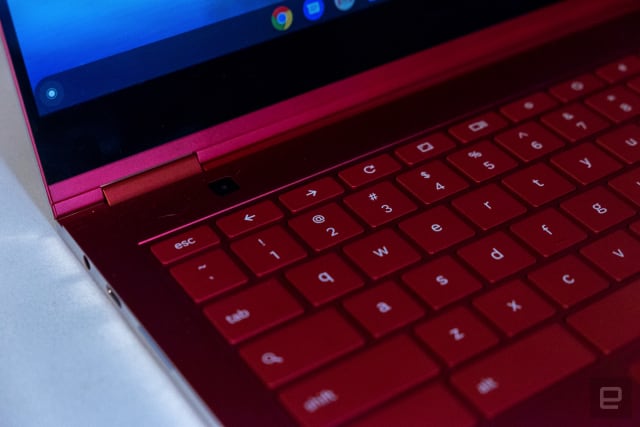
While I don’t really care about being able to flip the screen around, the Galaxy Chromebook excels as a more traditional laptop. For starters, Samsung absolutely nailed the keyboard here. It’s quiet and comfortable, possibly even more so than the Pixelbook Go. It’s quickly become one of my favorite computers to type on. It’s the same keyboard layout you’ll find on most Chromebooks, with one notable exception. There’s a fingerprint reader, right where Touch ID sits on MacBooks. Setting it up was easy and, once I figured out how it wanted me to position my finger, it was a reliable and fast way to sign in.
Nathan Ingraham / Engadget
The trackpad isn’t quite as inspired. It’s smooth and responsive, but just a little bit too small, particularly in the vertical direction. There’s a good amount of space between the edge of the chassis and the top of the keyboard, so I wish Samsung had pushed things up a bit to make for a bigger touchpad.
But if that were the case, there might not be room for the camera embedded in the keyboard deck. Don’t worry, it’s not for video chat. Samsung says it’s primarily there for taking pictures of a whiteboard in class, for example, or for scanning documents. That requires flipping the screen around so you’re in tablet mode, which makes sense -- but Chrome OS has never handled quick switching between those two modes, and the first time I tried it, all the apps I was using crashed. It’s not a feature I rely on, but it’s there if you need it.
When looking at the Galaxy Chromebook’s screen, the first thing you’ll probably think is “Wow, those bezels are thin!” It’s true -- Samsung says they’re 3.9mm wide, though the top border is slightly thicker to make room for the video chat camera. The second thing you’ll probably think is “Wow, that bottom bezel is huge.” And it is -- over an inch thick, in fact. Taken as a whole, the three tiny bezels and one big one doesn’t look bad, per se, but it really makes me wish the screen extended further down.
The Galaxy Chromebook may sport an impressive 4K resolution, but the 16:9 aspect ratio just feels too limiting to me these days. Even Apple’s 16:10 laptops feel significantly more comfortable, to say nothing of the taller 3:2 ratio you’ll find in a smattering of computers these days, like Microsoft’s Surface Laptop and Google’s own Pixelbook.
In happier news, this panel looks excellent. It’s the first OLED display on a Chromebook, and the high contrast, bright colors and deep blacks were all pleasing to my eyes. The 4K resolution makes everything extremely sharp, from websites to photos and movies. Going back to my MacBook Pro was a bit of a drag, although I will say that Samsung’s display almost exaggerates colors beyond their natural hues, a common complaint with the company’s smartphone displays.
The Galaxy Chromebook also has a feature called Ambient EQ, which works like True Tone on Apple displays. That is to say, it matches the color temperature of the screen to your surroundings, a first for a Chromebook. While the idea is the same as True Tone, Ambient EQ is definitely more aggressive in terms of the adjustments it makes -- the color temperature is very warm and yellow even in rooms where I thought I had pretty neutral light. Naturally, you can turn this feature off, something I’d recommend whenever working with photos or watching a video.
My main issue with the display Samsung chose is the same I’ve had with multiple recent Chromebooks: the 16:9 aspect ratio. For a while, a bunch of Chromebooks were using taller screens that displayed more vertical content (something you’ll also find on Microsoft’s Surface hardware), but it seems the tide has turned back to the default 16:9 ratio. It’s good for watching video or splitting the screen between two apps, but I pretty much always found myself wishing I could see more of a document, web page, or chat I was in.
Nathan Ingraham / Engadget
In use
For now, Samsung is only selling one configuration of the Galaxy Chromebook, which includes a 10th-generation Intel Core i5 processor, 8GB of RAM and 256GB storage. That’s plenty to run just about everything I need in Chrome OS without an issue. That includes a few browser windows with multiple tabs in each, plus Chrome apps for Google Keep, Todoist, Trello, YouTube Music, Tweetdeck, Slack, Hangouts and Telegram. For those basic needs, the Galaxy Chromebook had more than enough power; I never felt like I was pushing things too far when opening more and more tabs, and I also didn’t notice any hiccups in music playback.
Since the Galaxy Chromebook can flip around and has a built-in pen, I tried a handful of different sketching and note-taking apps. I have no fine artistry skills, but I still could get a sense of how the pen worked. The good news is that note-taking in Google Keep is near lag-free, which hasn’t always been the case. Google’s simple, built-in Canvas Chrome app also performs quite well.
As for third-party apps, MyScript Nebo also had low lag and was able to turn my handwritten notes into text I could copy and share anywhere. Other apps, like Infinite Painter and Adobe Sketch, were laggy enough that I couldn’t imagine anyone using them to do serious work.
As with most other Chromebooks I’ve used, I still feel features like a 360-degree hinge and a pen are nice to have, at best -- but hardly essential. My main concern is how the Galaxy Chromebook holds up as a laptop. Its powerful hardware and excellent keyboard ensured it excelled in that department. As I mentioned earlier it’s already one of my favorite computers to type on, despite the lack of vertical screen real estate.
Unfortunately, there is one massive problem: The Galaxy Chromebook’s battery life is unacceptable. In a test of my basic daily routine, I failed to clear the four-hour mark multiple times. The best I did was three hours and 52 minutes of use before the laptop shut down. When looping an HD movie stored on the laptop’s drive, I got five hours and 11 minutes before the battery died. The clear cause of this is the notoriously power-hungry 4K display, but that doesn’t make it OK. If Samsung was hell-bent on that high-resolution display, it could have made the Galaxy Chromebook a little thicker with a bigger battery. Or it could have kept the slim profile but went with a lower resolution. But doing both means that this will not be a reliable workhorse for people who need to spend a lot of time away from a charger.
The competition
Nathan Ingraham / Engadget
The obvious competitor for the Galaxy Chromebook is Google’s own Pixelbook. They’re both priced at $999 and have similarly thin and light bodies as well as a 360-degree hinge. The Pixelbook has a taller, 3:2 aspect ratio screen which I greatly prefer -- but it also has huge bezels that looked out of place in 2017, let alone now. Speaking of 2017, yes, the Pixelbook is about two and a half years old now. As such, it’s running a 7th-generation Intel Core i5 processor in its default configuration, not the 10th-generation chip found in the Galaxy Chromebook. The Pixelbook still runs well, but it’s hard to swallow the idea of spending that much money on a machine with an aging processor.
Another good point of comparison is Google’s Pixelbook Go, released in late 2019. It’s significantly cheaper than the Galaxy Chromebook, starting at $649. But that only gets you an Intel m3 processor and 64GB of storage. The closer comparison is the $849 model which steps up to an 8th-generation Core i5 processor and 128GB of storage. The Galaxy Chromebook still wins on processor and storage, and for that money you also get a more refined design, the 360-degree hinge, built-in pen and a 4K display. However, the Pixelbook Go has excellent battery life, something I cannot say about Samsung’s latest.
Another new entry to the premium Chromebook space is coming from ASUS in the form of the Chromebook Flip C436. I haven’t had a chance to try that laptop yet, although ASUS has made some of the best Chromebooks on the market in years past. The Flip C436 will also feature Intel’s 10th-generation processors, so it should make for a good comparison to what Samsung features in the Galaxy Chromebook. ASUS initially said the Flip C436 would be available by the end of March -- they didn’t make that date, but we should know more about it soon.
Nathan Ingraham / Engadget
Wrap-up
Samsung’s latest Chromebook does many things right. It’s a delight to type on, it impresses with a very compact design, and the screen looks brilliant. In many ways, it’s a clear successor to Google’s aging Pixelbook. But for $999, it’s almost impossible to forgive the poor battery life, especially given that there are other options for powerful Chromebooks out there. Not to mention that you could get Apple’s just-updated MacBook Air or Microsoft’s Surface Laptop 3 for that price. I can accept that a laptop with a 4K display won’t last 10 hours. But in 2020, I can’t recommend one that doesn’t even last four.
The FCC announced today all carriers and phone companies must adopt the STIR/SHAKEN protocol by June 30th, 2021. The regulatory requirement is designed to combat robocalls, specifically those that try to hide their phone numbers by allowing carriers to authenticate caller IDs, and letting people know they should pick up the phone rather than ignore a spoofed robocall.
The FCC has been slow to mandate any kind of anti-robocalling technology. Today’s approval only comes after Congress voted last year to require STIR/SHAKEN to be implemented and for the FCC to oversee it. Before then, FCC chairman Ajit Pai had attempted to encourage phone service providers to voluntarily implement the protocols. Many had begun to do so, but implementation had been slow, despite the frustrating uptick in robocalls in recent years.
The agency says the widespread adoption of STIR/SHAKEN will reduce the effectiveness of illegal spoofing, help law enforcement agencies identify bad actors and, most importantly, allow carriers to identify spammers before they ever call your phone. The FCC estimates fraudulent call schemes cost Americans approximately $10 billion every year. FCC Chairman Ajit Pai started pushing carriers to adopt the protocol in 2018.
While the regulatory requirement to support STIR/SHAKEN is a step in the right direction, it won't magically solve the scourage of robocalls overnight. It's not enough for carriers to merely implement the protocol on their own. They must also test that their implementation works with other networks. In other words, it's not something your wireless provider can just turn on. Moreover, as a consumer, you also need a device that can display the "Caller Verified" notification when someone calls you. While most modern smartphones support the feature out of the box, other handsets will need to be updated.
THE TRACED ACT REQUIRES THE AUTHENTICATION SYSTEM TO BE IMPLEMENTED.
Even at the end of June 2021, the system won’t be foolproof. Phone providers only have to apply the technology to the IP-based portions of their networks (so phone systems that still rely on older tech are exempted), and the FCC is working to extend the deadline for smaller phone companies by a year.
Once the technology is in place, phone providers still have to integrate their authentication systems with each other. The TRACED Act, passed by Congress, requires phone providers to work toward that integration, but there aren’t really deadlines on how quickly it has to happen.
Still, the June 2021 deadline means that things are finally moving. STIR/SHAKEN very likely won’t have fixed the robocall problem by then, but it should hopefully be in a position to soon put in a dent in it.
Apple has bought weather app Dark Sky, which is highly regarded for its radar maps and accuracy of its hyperlocal, by-the-minute weather predictions. It'll still be available on the iOS App Store, as you might expect, and will be shutting down the Dark Sky Android and Wear OS apps in 1 July, Dark Sky announced in a blog post today. "Our goal has always been to provide the world with the best weather information possible, to help as many people as we can stay dry and safe, and to do so in a way that respects your privacy," the Dark Sky team wrote in a blog post. "There is no better place to accomplish these goals than at Apple. We're thrilled to have the opportunity to reach far more people, with far more impact, than we ever could alone." Dark Sky's forecasts, maps and embeds will keep working on the web until July 1st. The website will stay online after then "in support of API and iOS App customers." As for the API, it'll remain active until the end of next year, but Dark Sky won't let anyone else sign up. There aren’t any changes coming to Dark Sky for iOS “at this time,” and you can still buy it on the App Store right now for $3.99. But you won’t be able to download the Android and Wear OS apps anymore, and if you already have them, you’ll only be able to use them until July 1st before they’re entirely shut down. If you still have an active subscription by that date, you’ll receive a refund, according to Grossman. It seems likely Apple will use Dark Sky's know how to bolster its own Weather app. Apple has used data from Yahoo and The Weather Channel to power the app over the years. You’ll also only be able to view weather forecasts, maps, and embeds on Dark Sky’s website until July 1st. The website will stay up after that date “in support of API and iOS App customers.” Dark Sky’s branding on its website has already been updated to “Dark Sky by Apple.”
Photo: Amazon Studios
New trailers: Killing Eve, Upload, Murder House Flip, and more
I’d completely expected to be writing a note this week about how the COVID-19 pandemic has largely shut down trailer production, but it turns out, my assumption was wrong. While things have certainly slowed down, streaming services are almost singlehandedly keeping up the new releases. If anything, this is a great moment for them to debut a new show or series since everyone is stuck indoors.
That said, we’ll see how long this lasts. Productions are being shut down for health reasons, and it seems like every major movie coming out in the next couple of months is being delayed. So there may come a point where the backlog of content thins out. I certainly suspect it’ll be a bit before we see any trailers for tentpole films.
For now, it’s a great moment to catch up on some old movies you haven’t watched in a while or check out a show you never got around to. My wife and I are now nearly a season into The Sopranos, something we newly have the time to spend watching through. Other than the occasionally strange ’90s music choices, it’s pretty good.
Check out 11 trailers from this week and last week below.
KILLING EVE
While I’ve heard that the show’s second season didn’t live up to its much-loved first run, this teaser for season three of Killing Eve looks wonderfully stylized, fun, and dramatic. The show returns April 12th.
# BLACKAF
Black-ish creator Kenya Barris has a new comedy series coming to Netflix about life as a successful black artist in Hollywood. Barris stars as a fictionalized version of himself, with Rashida Jones playing his wife. From just the first moment of this trailer, it seems like the show is off to a strong start. It debuts April 17th.
TIGERTAIL
Master of None co-creator Alan Yang makes his feature debut with Tigertail, a beautifully shot film about a Taiwanese factory worker moving to America. It comes to Netflix on April 10th.
UPLOAD
Greg Daniels, who led the US version of The Office, is back with a new sitcom for Amazon. Upload is about people who live in a digital “afterlife” after having their consciousness uploaded pre-death. So far, it mostly looks like an excuse to make some pretty low-hanging tech jokes (hilarious, there are in-app purchases...). The show debuts May 1st.
THE GREAT
Hulu has a ridiculous looking period piece comedy coming up that stars Elle Fanning as Catherine the Great. It’s hard not to think of The Favourite while watching this, but that’s not a bad thing — the series comes from one of the film’s co-writers. The show debuts May 15th.
DEFENDING JACOB
Chris Evans plays a father whose kid is accused of murder in this upcoming Apple TV Plus series. It’s based on a crime novel, and yeah... I just went ahead and read the entire synopsis on Wikipedia to find out if he did it or not. The show debuts April 24th.
RUN
The basic premise of Run is super twee — two exes follow through on an old agreement to drop everything, reunite, and run away together if their lives get boring — but the actual execution looks surprisingly fun and lively. It comes out April 12th.
THE WILLOUGHBYS
Netflix is turning Lois Lowry’s The Willoughbys into an animated film, and while it looks like the movie is filled with pretty conventional kids humor, the animation has an intricate stop motion-esque look to it. It comes out April 22nd.
BAD EDUCATION
Even though Netflix has made straight-to-streaming films a totally normal thing, I’m still a little skeptical about movies that go straight to HBO. But all that said: I’m very into this trailer for Bad Education, which is based on a real story about a beloved school leader whose years of theft starts to become exposed. It comes out April 25th.
MOST DANGEROUS GAME
I’m fully obsessed with watching Quibi trailers in a “let’s see just how much of a mess this is gonna be” kind of way. Most Dangerous Game is a movie “in chapters” up to 10 minutes long. There are two big stars in the lead, and despite my assumptions, it looks like a pretty altogether normal action movie. It comes to Quibi on April 6th, when the service launches.
MURDER HOUSE FLIP
Speaking of Quibi... here’s the trailer for what is likely its altogether most bonkers show. I absolutely hate that this is probably going to be its biggest hit. via theverge




:format(webp):no_upscale()/cdn.vox-cdn.com/uploads/chorus_asset/file/19882444/49747502797_ba4ef26976_3k.jpg)



/cdn.vox-cdn.com/uploads/chorus_image/image/66569002/upload_UPLO_S1_SG_103_00010_rgb.0.jpg)